Pink Transparent Star

Friday, August 26, 2011

Document Design: Screen vs. Print

Although screen documents and print documents share the same purpose of displaying information and graphic to it's readers, both are very different and face their own set of challenges and design parameters.The differences can be defined through,


Dimensionality
Print design is 2-dimensional with much attention focused on it's page composition, the layout. Web design however is both 1-dimensional and N-dimensional (Nielsen, 1999). This is further strengthened by Bear (2011) when she mentioned that page layouts in print designs are static as readers view the graphics and text columns on the page at the same size and place. In contrast, screen designs are more dynamic and fluid as readers can control how they view the pages.


Navigation
According to Nielsen (1999), the web is all about moving around. Hypertext navigation is the essence of the Web in the N-dimensional aspect of the web design. Bear (2011) explains that the only navigation in print is page turning. Navigation in a Web is different compared to the linear navigation of the pages of a book like a newspaper or a magazine.


Response Time, Resolution, and Canvas Size
Nielsen (1999), believes that print is much faster in speed, type, image quality and size of space than the Web. But this phenomena is bound to change as bandwidth now is so fast that downloading a web page is as fast as turning a page in a book. Not only that, screen resolution has become sharper while screens as as big as a newspaper or even bigger has emerged.


References
1. Bear, J, H, 2011, Print Design vs. Web Design, viewed 24th August 2011, <http://desktoppub.about.com/od/transitionprintweb/tp/Print_Design_vs_Web_Design.htm>


2. Hume, A, 2005, The Anatomy of Web Fonts Article, viewed 24th August 2011, <http://www.sitepoint.com/anatomy-web-fonts/>


3. Neilsen, J, 1999, Differences between Print Design and Web Design, viewed 24th August 2011, <http://www.useit.com/alertbox/990124.html>


New Forms of Media Publishing

The famous 9th of July rally happened recently demanded fair elections in Malaysia, 'Bersih 2.0' if not for new media publishing how could news like that travel at a speed where information can be obtained in less than 3 seconds? Not to mention information that is accurate and credible. It is through these new medias called Facebook, Twitter, Youtube, and online news.


Although some traditional news outlets feel threatened, others are adapting to this new change and practicing open publishing properties to their very own online versions. Mainstream media outlets like The Guardian have introduced blogs as part of their cites while BBC's website is posting reader's photos, sites solicit and reader-contributed contents. Journalists are now blogging live from court like in Baghdad allowing frequent updates near real time. (Washington Educational Department, 2011)


Even so, the new media and journalism has impacted the media in many ways good and bad in media theories, concepts, rules and regulations..These include the democratization of media because of low barriers to enter, demands of media's hegemony, a redefinition of credibility, the breakthrough of experts and watchdogs and the demands of readers in the journalistic action. New media has allowed the sharing of information in a community. Despite that, people have taken advantage of it and used it for their own purposes. Many false news were circulated around the new media like Twitter and Facebook about the happenings of the 'Bersih 2.0' Rally (Willis and Bowman, 2003).


The new media ecosystem is an enormous focus group which acts as a tool to communicate with the public (Hobson, 2005). It is a dynamic communication channel that create connections, cultivates influence while empowering employees and the public. Hence, building a genuine community.


References


1. Hobson, N, 2005, The new Media Ecosystem: Conversations, Influence and You, viewed 23rd August 2011, <http://www.nevillehobson.com/pubfiles/downloads/051020_NewMedia_FEIEA.pdf>


2. Washington Educational Department, 2011, The Internet's Impact on News Media, viewed 23rd August 2011, <http://depts.washington.edu/ccce/digitalMedia/newsimpact.html>


 3. Willis, C, and Bowman, S, 2011, About "We Media", viewed 23rd August 2011, <http://www.hypergene.net/wemedia/weblog.php>

Types of Blogging Communities & Methods to Build Them

Based on Owyang (2007), a blogging community is created when a group of people sharing the same interest gather together and communicate with each other sharing information using web tools. Holman (2011) proposed a few ways on how bloggers build a blogging community. It is through responding to commentators, writing posts in reaction to other bloggers and creating opportunities for local bloggers to meet.


Based on Nancy White (2006), there are three types of blogging communities. it is the Blogger Centric Community, the Central Connecting Topic Community and the Boundaried Communities. 


Blogger Centric Community.


Figure a: Blogger Centric Community
(Cited from White's blog, 2006)
The one blog is owned by one owner or organisation where power in this community is firmly in the central blogger’s control.From a subject matter perspective, single blog centric communities are almost broadcast-like, with the central blogger setting the conversational topic. 


The Central Connecting Topic Community.


Figure b: Central Connecting Topic Community
(Cited from White's blog, 2006)
In topic centric communities both power and identity is distributed across the community. Topic centric communities have no single technological platform, with each blogger selecting their own tool. What links them is hyperlinks, in the form of blogrolls, links to other blogs within blog posts, tagging, aggregated feeds (using RSS), trackbacks and comments.

                                                                                                                                        
The Boundaried Community.


Figure c: Boundaried Community
(Cited from White's blog, 2006)
Typically members register and ‘join’ the community and are offered the chance to create a blog. Examples include the huge teen oriented site, MySpace.com and Farmer’s (2006) Australian free educational blogging sites EdublogsESLblogsUniblogs and Learnerblogs.


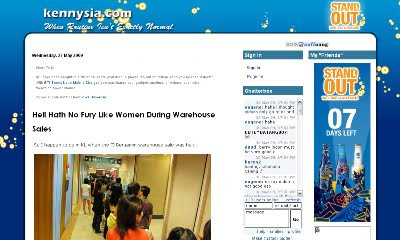
(Cited from Google.com, 2011)
Kennysia.com is a very famous Malaysian blogger which started out from a personal blog and in later years became a great advertising revenue. His blog is an example of the Blogger Centric Community.


References 


1. Anthony, 2009, What is a Blogging Community?, viewed 22nd August 2011, <,http://www.thetraveltart.com/what-is-a-blogging-community/>


2. Owyang , J, 2007, Defining the Term: Online Community, viewed  22nd August 2011, <http://www.web-strategist.com/blog/2007/12/28/defining-the-term-community/>


3. Crowe, P, Holman, K, 2011, How to Create a Blogging Community, viewed 22nd August 2011, <http://www.spiceupyourblog.com/2011/03/how-to-create-blogging-community.html>


4. White, N, 2006, Blogs and Community - Launching a New Paradigm  for Online Community?, viewed 22nd August 2011, <http://kt.flexiblelearning.net.au/tkt2006/edition-11-editorial/blogs-and-community-%E2%80%93-launching-a-new-paradigm-for-online-community>

Classification of Blogs & Opinion on the Best Classification Approach

About 30,000 - 40,000 new weblogs consisting of different combinations of styles are being created everyday making identifying them strenuous. With all the blogs on the internet, it is only prudent that blogs should be classified for a better and convenient searching experience (Sifry, 2005).


One can classify a blog by its form of authorship. (Werbach, 2001). Bloggers that act alone or individually makes up the majority of blogs. However, some blogs are collaborative in nature. This means that some blogs have multiple writers and can be an open-source blog. Examples would be www.indymedia.org and www.slashdot.com.


Another way to categorize blogs is through subject matter. This includes:


1. Media digests - comes with commentaries (Roberts-Witt, 2001)


2. Academic/ professional interest (Block, 2001)


3. Traditional link-filters. (Blood, 2000, Fleishman, 2001, Higgins, 2000 and Werbach, 2001)


4. Me-Zines - Alex Kuczynski defines it as an 'electronic magazine featuring opinions from one'. Me-zines can also be controversial  like Drudge Report (www.drudgereport.com) and political (Kuczynski, 2001).


5. Personal journals -vary in design and content. (Rainer, 2001 and Roberts-Witt 2001)


In comparison to both ways of classification, Werbach (2001) uses authorship to categorize blogs. It is a more general way as the number or authors and not the contents of the blog is used to differentiate a blog from another while most writers classify a blog through subject matter which is more specific and detailed as supported by Chettri (2011) and Carter (2011).


References


1. Sifry, D, 2005, State of the Blogosphere March 2005, Part 1: Growth of Blogs, viewed 20th August 2011, <http://www.sifry.com/alerts/archives/000298.html>


2. Chettri, S, 2011, What is Blogging? What are the Different Types of Blogs?, viewed 20th August 2011, <http://www.netchunks.com/different-types-of-blogs/>


3. Carter, D, 2011, Blogging What You Don't Know, viewed 20th August 2011, <http://www.articlebiz.com/article/193242-1-blogging-what-you-dont-know/ >


4. Funnel, A, Davies, A, 2008, A Taxonomy of Blogs, viewed 20th August 2011, <http://www.abc.net.au/rn/mediareport/stories/2008/2372882.htm#transcript>

Blogs as Current Phenomenon & Benefits of Blogging to the Community

Blogs, are an emerging technology gaining popularity in our community as it provides a space for one to freely write about their thoughts in a form of a Weblog or an online journal and comment on another blog. According to a survey done by Technorati in 2009, as many as 133 million blogs were tracked since the year 2002.

technorati-state-of-blogosphere-size-2008.jpg
(Cited from Technorati, 2011)

Most blogs whether in Europe, Western countries and Asia are either  individualistic or corporational. (Duermyer, 2011) They are used as a personal space to document experience, express creativity and interest, share practical knowledge or to represent a business or organisation with a purpose to keep in touch with family and acquaintances. However, there are certain trends of blogs which are more apparent in different countries. For instance, America where many blogs are to keep up with trends like fashion and even Hollywood celebrity gossips. One cannot miss the very famous Perez Hilton's blog which gets an astounding 10,200,000 estimated monthly visitors. (eBizMBA Rank, 2011)


In Malaysia, political blogs are fast rising to be hot-spots for quick and accurate information. Although controversial, it is one of the only few places Malaysians can voice out their views towards the political parties as the citizens are suppressed by censorship laws and regulations by the government. It is also used by political leaders for campaigning purposes and to spread influence. Among the famous political blogs are Malaysia Today by Raja Petra Kamarudin and 1Malaysia by Datuk Seri Najib Razak.


Social blogs are important in the sharing of information while political blogs are vital for discussing and debating politics as opinions from the public all over the world can be obtained. Blogs are crucial in the advertising industry as it contributes to advertising companies like Nuffnang and Advertlets in Malaysia.


References


1. ebizMBA, 2011, Top 15 Most Popular Blog, August 2011, viewed 18th August 2011, <http://www.ebizmba.com/articles/blogs>


 2. Technorati, 2011, State of Blogosphere 2011, viewed 18th August 2011, <6256/technorati-state-of-blogosphere-size-2008jpg/>


3. John, N, 2006, Blogging and the Emerging Media Ecosystem, viewed 18th August 2011, <http://reuteursinstitute.politics.ox.ac.uk/about/discussion/blogging.html>


4. Duermyer, R, 2011, Blogging - What is the Meaning of Blogging?, viewed 18th August 2011, <http://homebusiness.about.com/od/homebusinessglossar1/g/blogging.htm>


Thursday, August 25, 2011

Introduction


The purpose of this blog is to discuss and comment on the issues of  publication and design. As a student enrolled in this class from Taylor's University, Malaysia, I hope to be more educated in this subject as I explore the issues of publication and design in a more in-depth manner.

The target audience of my blog are students and viewers taking the same course as myself and professionals in this field as I believe that blogging is a means where many can benefit from because blogging allows interaction amongst individuals disregarding geographical location and language barriers. 

Therefore, ideas and comments are welcomed as these feedback would be resourceful and beneficial to everyone.Sharing of information and opinions regarding my posts in this blog beginning from now and in the future is very much appreciated in my academic research on the issues of publication and design.

Thank you.